
News & Events
Let Nagasaki Be the Last A-Bombed City - 24th World Congress PPNW
Let Nagasaki Be the Last A-Bombed City
Message from the 24th World Congress of the
International Physicians for the Prevention of Nuclear War (IPPNW)
Dr. Indervir Gill
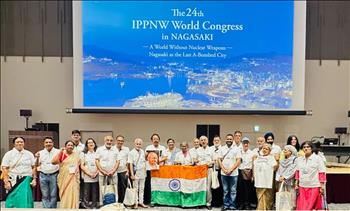
The 24th World Congress of the International Physicians for the Prevention of Nuclear War (IPPNW) was convened in Nagasaki, Japan, from October 2 to 4, 2025. Held on the 80th anniversary of the atomic bombings of Hiroshima and Nagasaki, the Congress brought together the global medical community to reaffirm a simple but urgent message: the world must abolish nuclear weapons before they abolish us.
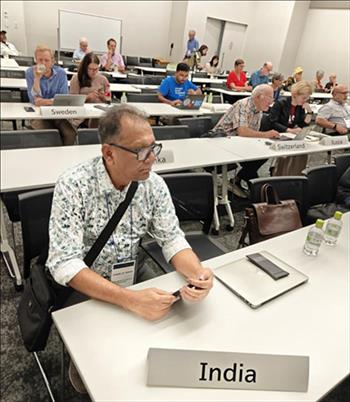
More than 350 doctors, nearly 50 medical students, and delegates from 35 countries attended the Congress. A strong 28-member Indian delegation participated under the leadership of Dr. Arun Mitra, National President of the Indian Doctors for Peace and Development (IDPD) and former Co-President of IPPNW. The IDPD team represented diverse states of India, reflecting the country’s growing engagement in global peace and disarmament efforts. The IDPD participants hailed from Jammu & Kashmir, Punjab, Rajasthan, Maharashtra, Telangana, Tamil Nadu, Puducherry, Bihar and Tripura.
The Central Presence of Hibakusha
The emotional heart of the Congress was the presence of the Hibakusha—survivors of the 1945 atomic bombings, whose average age is now 86. Their testimonies, filled with pain yet remarkable resilience, served as a moral compass for the event. Over the decades, the Hibakusha have consistently pleaded with the world to ensure that no human being ever again experiences the horrors they endured.
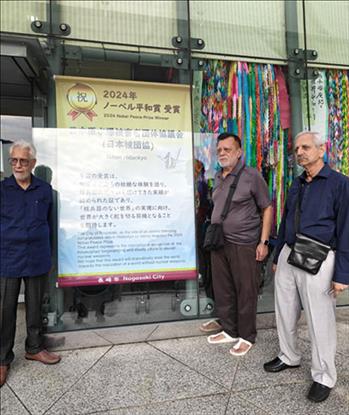
Nihon Hidankyo, the organization formed by Hibakusha in 1956, was recently awarded the 2024 Nobel Peace Prize for its tireless advocacy for the abolition of nuclear weapons. Its slogan “No More Hibakusha” resonated throughout the Congress. One of the most moving speakers was Terumi Tanaka, who survived the Nagasaki bombing at age 13 and is now 93. Tanaka recounted the blinding flash, the destruction of his city, and the loss of five family members. His message to young medical students was clear: carry forward the struggle for a nuclear-free world.
A Gathering of Nobel Peace Laureates
Four Nobel Peace Prize-winning organizations jointly addressed the Congress:
IPPNW – Nobel Peace Prize 1985
Pugwash Conferences on Science and World Affairs – Nobel Peace Prize 1995
International Campaign to Abolish Nuclear Weapons (ICAN) – Nobel Peace Prize 2017
Nihon Hidankyo – Nobel Peace Prize 2024
Their presence underscored the scientific, humanitarian, and moral consensus against nuclear weapons. The leaders of these organizations expressed deep concern that the world is again drifting toward nuclear confrontation.
The IPPNW Legacy
Founded in 1980 by Dr. Bernard Lown of the United States and Dr. Yevgeny Chazov of the Soviet Union, IPPNW emerged at a time when the world was dangerously polarized between two nuclear superpowers. These doctors argued that ideological differences could not outweigh the shared human interest in survival.
Over 45 years, IPPNW has grown into a federation of medical groups in 56 countries. Its scientific research—especially on the medical impacts of blast, heat, and radiation—helped shift global opinion during the Cold War. IPPNW’s medical warning remains one of the clearest ever issued: “A nuclear war would be the final epidemic—there will be no cure and no meaningful medical response.”
The Danger Today: Worse Than the Cold War
Multiple speakers warned that nuclear risks are now greater than at any time since 1945. Nine countries collectively possess over 12,300 nuclear weapons, many of them far more powerful than those used on Japan.
Growing global instabilities—ranging from the ongoing conflict in Gaza and the Russia-Ukraine war to tensions in the Korean peninsula and India-Pakistan border—make the possibility of miscalculation alarmingly real. Additionally, technological developments such as AI-driven control systems, cyber vulnerabilities, and hypersonic missiles introduce new risks of accidental or unauthorized nuclear launch.
Scientists at the Congress highlighted research showing that even a limited regional nuclear war—for example between India and Pakistan—could inject soot into the atmosphere, disrupt global climate patterns, collapse agricultural systems, and lead to mass starvation far from the conflict zone. It gave impetus to the anti nuclear movement based on the medical consequences of nuclear war. The organization’s persistent work laid the foundation for public pressure that contributed to arms control agreements.
Global Momentum for a Nuclear Ban
The Treaty on the Prohibition of Nuclear Weapons (TPNW) was a strong focus of discussions. Thanks to sustained public campaigns led by ICAN and supported by IPPNW, the treaty has now reached 95 signatories and 74 State Parties, marking significant global momentum toward delegitimizing nuclear weapons.
As Melissa Parke, Executive Director of ICAN, said, “Abolishing nuclear weapons will be a moral milestone comparable to the abolition of slavery.” She emphasized that political will, not technical expertise, is what now stands between humanity and nuclear abolition.
Doctors’ Duty: Prevent What Cannot Be Treated
The Congress concluded with the Nagasaki Declaration, which stated:
“As doctors, we understand that we must prevent what cannot be treated. Nuclear war is a catastrophe from which there will be no escape. Together with the voices of the Hibakusha, we call for the complete abolition of nuclear weapons and the creation of a more peaceful world.”
The concluding slogan captured the essence of the entire event
“Nagasaki must be the last place to suffer an atomic bombing.”
New Leadership Team
On the final day, IPPNW elected its new global leadership. In a historic moment, three women—
Dr. Kati Juva (Finland), Dr. Olga Mironova (Russia), Dr. Inga Blum (Germany) were elected as Co-Presidents of the organization, marking a milestone for women’s leadership in international peace movements.
India’s contribution was also recognized when Dr. Shakeel-ur-Rehman, General Secretary of IDPD, was elected to the IPPNW Board. His election reflects the growing role of Indian doctors in advocating for peace, disarmament, and global security.
A Call to the World
The 24th IPPNW Congress in Nagasaki ended with a strong reminder: the survivors of Hiroshima and Nagasaki are fading away, but their message must not. As global tensions intensify, the responsibility to secure a nuclear-free future lies with governments—but also with citizens, scientists, students, and especially the medical community.
The clear message from Nagasaki was this
Humanity cannot afford another nuclear war.
Nagasaki must remain the last A-bombed city—forever.